01
Every new hire
Replacing one employee costs 50 to 200 percent of their annual salary, by SHRM's estimate — up to 200 percent for a manager. A new hire takes a year to reach the output of the person they replaced, on full pay throughout.

Process and agent orchestration
Your company already knows how it operates. That knowledge sits in people's heads, walks out when they leave, and cannot be given to an AI agent because nobody ever wrote it down.
STEP AI holds your processes and your agents in one system. Describe a role once — it onboards your people, shows you what can go to an agent, and hands it over one step at a time.
By invitation. We take a limited number of onboardings per quarter so every deployment gets an operator, not a login.
Early access
Request a demo
Tell us which role costs you the most to fill, and we will come back with what it would take to move part of it to agents — and what it would not be worth touching.
01 — The cost nobody books
None of the three sits in a line item, which is why none of them has ever been attacked directly. Then AI arrived and made all three worse at once.
01
Replacing one employee costs 50 to 200 percent of their annual salary, by SHRM's estimate — up to 200 percent for a manager. A new hire takes a year to reach the output of the person they replaced, on full pay throughout.
02
What leaves with a person is the part nobody wrote down: which client will not tolerate what, where this usually breaks, what was already tried. The company pays a second time, in the mistakes of whoever takes the seat.
03
The rule goes out by email. A month later some share of the team is still working the old way and nobody knows which share. The invoice arrives later as rework, penalties and churned accounts.
Global spend on corporate training runs at $101.8 billion a year, about $954 per person. It buys courses. It does not buy evidence that anyone applies what they learned, or that they are still applying it after the rule changed.
02 — Why this got urgent
The budget is already committed and the failure mode is already visible. Companies bought the tool and have nothing to load it with.
The projects do not fail on the model. They fail because the knowledge an agent needs lives in a folder of prompts on somebody's laptop, and no one owns keeping it current.
03 — How STEP AI works
Today a company documents process in one tool, trains people in a second, and builds agents in a third. None of them talk, so a rule change reaches people by email and reaches agents not at all.
Step 01
Lay the work out as steps: what happens here, under which rules, what counts as a good result. The same description onboards new people and they confirm they have absorbed it — so documenting process and training staff stop being two separate jobs.
Step 02
STEP AI flags the steps that are eligible and ranks them by how often they run and what an error costs. You get a list to start from, not a directive to adopt AI.
Step 03
Not a project, not a ticket to the IT department. The agent inherits the same description your people work from, and the same hard limits: what it must never do, where it has to call a human.
Step 04
The owner sees what the agent did and why, and raises its autonomy as trust builds. Lowering it again is one click. The person who ran the work becomes the person who runs the agents that run it.
04 — Inside the product
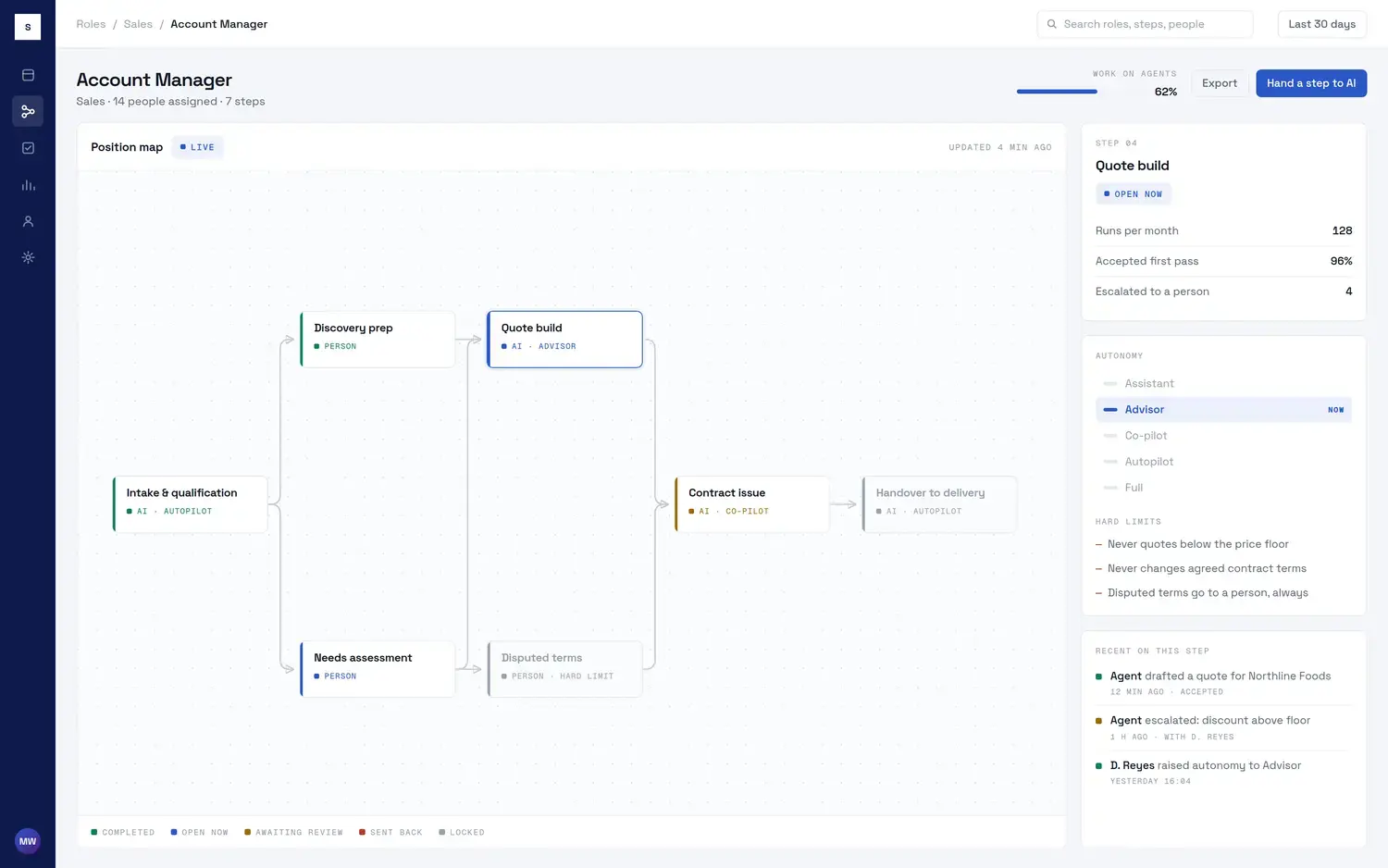
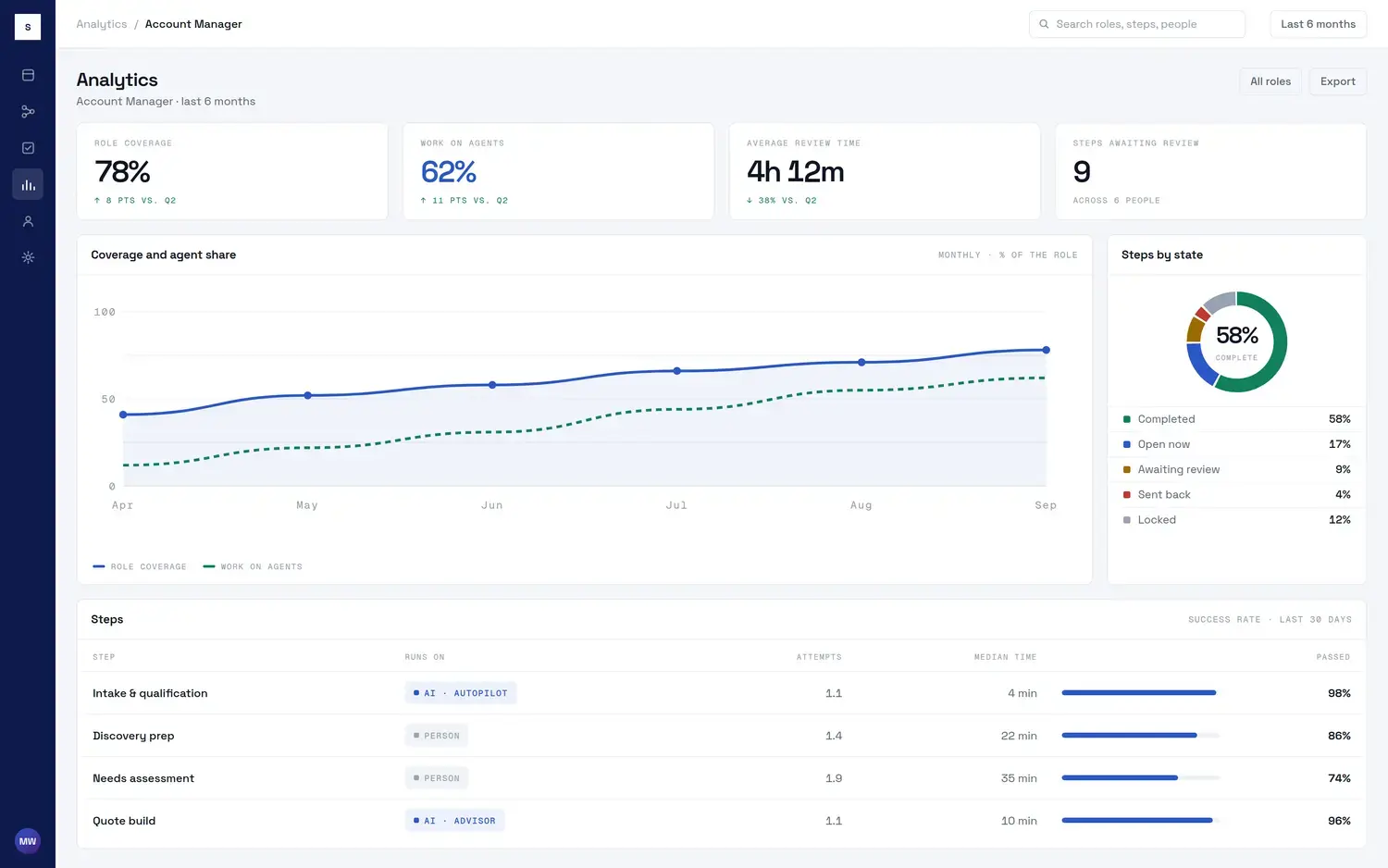
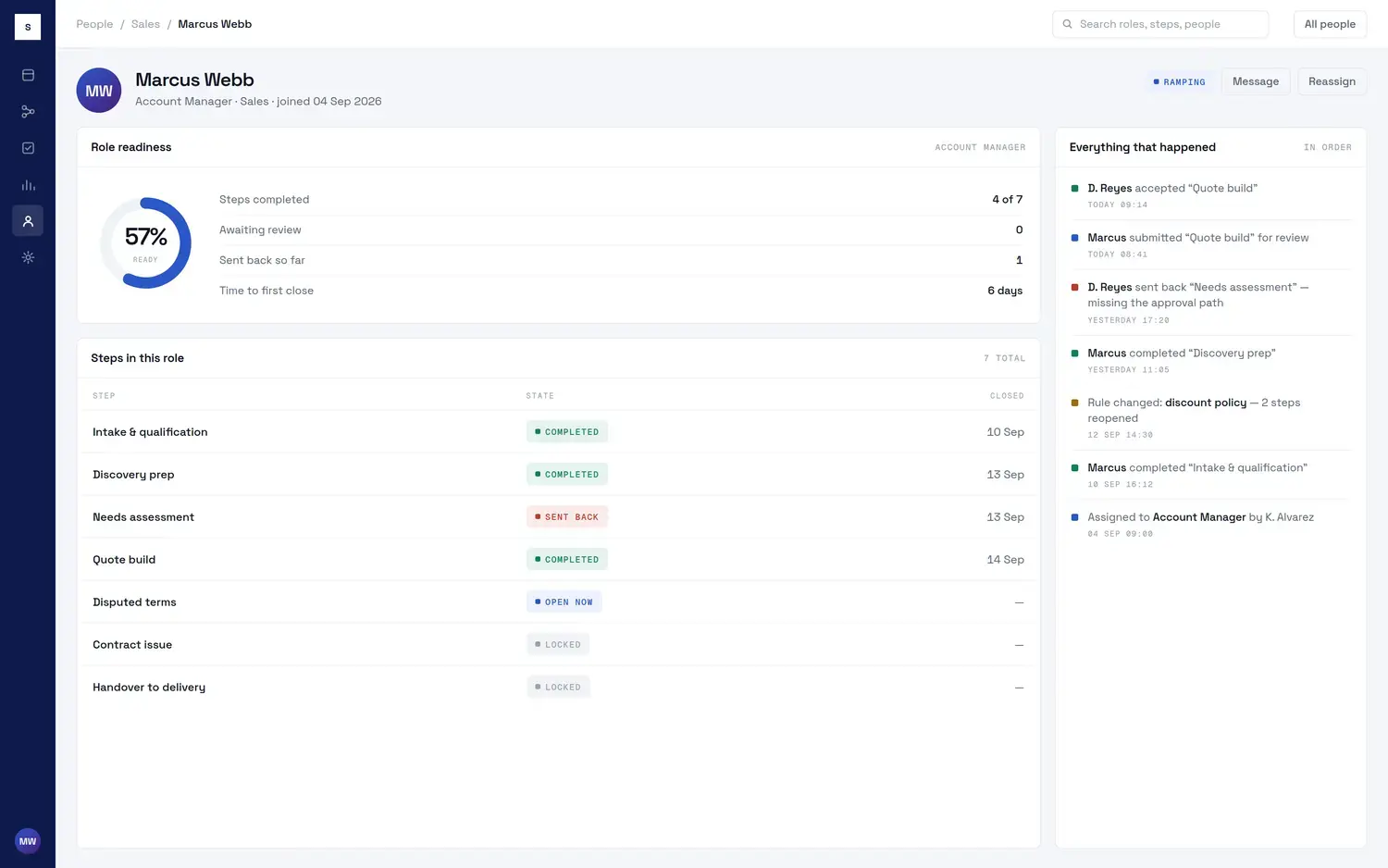
One screen holds the work, the people doing it and the agents doing the rest. Every colour is a state somebody is sitting in right now.
05 — Five rungs of autonomy
An agent does not arrive with full authority and it does not get it for the whole process at once. It is granted for one step, raised on evidence, and lowered in one action when the evidence turns.
| Rung | What the agent does | What the person does |
|---|---|---|
| Assistant | suggests options | decides everything |
| Advisor | prepares the decision and explains the reasoning | approves each one |
| Co-pilot | handles standard cases | reviews in batches, works the exceptions |
| Autopilot | handles everything routine on its own | watches the numbers, steps in on anomalies |
| Full | handles the non-standard too | sets the rules and the hard limits |
Change a rule once and both sides move: your people are required to re-certify, and every agent touching that rule drops a rung until it proves it has absorbed the change. In three separate tools that connection never gets made — which is most of why the cancelled projects get cancelled.
06 — Measured, not projected
STEP AI has been in production since 2020. The first deployment was a 60-person engineering firm — ours — which is where the numbers below were measured, before any of it was sold to anyone else. Since then: commercial deployments, a government deployment, and a certification program for financial-sector specialists.
Own company · measured over 18 months of operation · IP registered in Canada
07 — Fit
Size and industry matter far less than repetition. If the same work happens more than once a week it can be written down — and once it is written down, part of it can be handed over.
We say no to these. The deployment does not pay for itself on either side, and we would rather say so in the first conversation.
08 — Book a demo
Tell us which one it is. We come back with a straight read: which parts of it could move to agents, which parts should not, and what the first eight weeks would look like.
No deck, no discovery marathon. If the role is a poor fit we say so and tell you why — that answer is worth having too.
Book a demo
Request a demo
Thirty minutes, on your own process rather than a canned walkthrough. We take a limited number of onboardings per quarter.
09 — Frequently asked questions
If yours is not here, ask it in the form above and we will answer it in writing before anyone books time with you.
STEP AI is a platform where a company's processes and its AI agents live in one place. You describe how a role is actually done, once. That description onboards your people and it is also what an agent runs on. From the same screen you can see which steps are eligible to move to an agent, hand one over, and manage what the agent produces.
A learning platform delivers courses and records that someone completed them. It has no opinion about whether the work is being done that way afterwards, and it does not change anything when a rule changes. STEP AI records a step as closed only on evidence, and when you edit a rule the people who depend on it are required to re-certify while any agent touching it drops a rung of autonomy until it proves it has absorbed the change.
Agent builders answer the question of how to assemble an agent. They leave the harder questions to you: where the knowledge comes from, who owns the result, what the agent must never do, and what happens when it gets something wrong. STEP AI starts from the documented process, so the agent inherits the same description and the same hard limits your people work under, and a named person owns the outcome.
No. Describing an entire company before switching anything on is the pattern that kills these projects. We start with one role, usually the one that costs the most to fill or turns over fastest, and it goes live in weeks. The map grows because the last step paid for the next one.
We work out how the job is actually done rather than how it is written down, put it into the system so both people and machines can use it, run the first agent in shadow mode next to your team, compare the two, and hand you the controls. You see a number at the end of it, not a report.
No, and the product is built to prevent it. Execution is delegated, knowledge never is. A step handed to an agent stays in your people's training as knowledge they are still required to hold. They stop doing it. They do not stop understanding it. That is what makes rolling a step back an ordinary action instead of a crisis.
It changes in one place and propagates in both directions. Edit the rule, and your people are required to re-certify while every agent touching it drops a rung until it proves it has absorbed the change. You watch that happen on a dashboard instead of wondering who read the email.
Roughly a quarter of operational work is genuinely agent-ready today. We do not claim more. Promises that fall apart in month three cost more than the deal was worth, so we would rather tell you which parts are not worth touching.
Everything the system accumulates, meaning the descriptions, the rules, the decision history and the tests, is stored as plain structured text rather than fine-tuned weights or one vendor's prompt format. Changing models is an operation: connect the new one, run the existing tests, compare, switch if it holds. Your accumulated work does not move.
You do. The descriptions, rules and decision history are your operating knowledge and they stay yours, in a form you can export and read without us. That is the point of the product: the knowledge stops living in people's heads and becomes something the company holds.
Their job changes shape rather than disappearing. The person who ran the work becomes the person who runs the agents that run it, which means reviewing what the agent produced, deciding when it has earned more freedom and pulling it back when it has not. That is a real job and it is one nobody in the company was doing before.
Pricing is per role: a one-time deployment plus an annual subscription, with compute billed at cost so the price does not move with model pricing. Each role after the first costs less because the method is already in place. We quote after we have seen one role, so the first step is a demo. Tell us which role costs you the most and we will come back with what it would take, and what would not be worth touching.